Getting Basketball Fit Without Killing the Fun
Basketball is not a running sport, it is a stopping and starting sport. Conditioning that ignores that is mostly wasted.

- Basketball fitness is short bursts with short recovery, not steady running.
- Conditioning with a ball beats conditioning without one, at every age.
- Small-sided games are the best conditioning tool there is.
- Never use running as a punishment. It teaches kids that fitness is a penalty.
The default answer to a tired-looking young team is laps. It is also close to the least useful thing you can do, because it trains an energy system basketball barely uses.
What the sport actually demands
Watch a possession. Sprint, stop, change direction, jump, jostle, sprint again. Then a few seconds of nothing. Then again.
That is short repeated efforts with incomplete recovery. A player who can run five kilometres steadily may still be finished after four hard possessions, because those are different capacities.
Condition with a ball
The easiest upgrade available. Almost any conditioning drill improves if a ball is in it, because you get fitness and skill in the same minutes, and because kids will work considerably harder when it is basketball rather than punishment.
- Full-court layups on a clock. As many made layups as possible in 90 seconds, alternating hands.
- Suicides with a dribble. Same as the running version, but ball in hand, eyes up. Slower and far more useful.
- Shoot and sprint. Shoot, chase the rebound, sprint to the far line, come back and shoot again. 60 seconds.
Small-sided games are the best tool
Three-on-three in a half court will condition a young player more effectively than any drill, because the work is continuous, the stops and starts are real, and nobody is counting down the seconds until it ends.
It is also where decisions get trained at the same time, which no amount of running does. This is a large part of why we run 3x3 sessions as their own thing.
What to leave alone
Heavy lifting and adult-style strength programmes are not the answer for young players. Bodyweight movement, jumping and landing well, and simply playing a lot builds what a growing athlete needs. Loading a body that is still growing to chase a number is a bad trade.
Never as a punishment
The most damaging habit in youth sport. Running as a penalty for losing a drill teaches a child that fitness is something done to them when they fail.
Conditioning should be framed as the thing that lets them still be good in the fourth quarter. That is true, and it is a much better reason to do it.
What changes by age
Under 10: conditioning as a separate thing should barely exist. Games, tag, relays with a ball. A child who plays hard three times a week is conditioned, and formal fitness work at this age mostly teaches them that exercise is boring.
10 to 13: short burst work with a ball starts to earn its place, and this is the right age to learn to jump and land properly, which quietly prevents half the knee and ankle trouble that shows up later.
14 and up: now the engine matters. Repeated sprint work, real small-sided intensity, and bodyweight strength. A high schooler who can still defend in the fourth quarter makes teams, because most of their competition cannot.
The test worth running
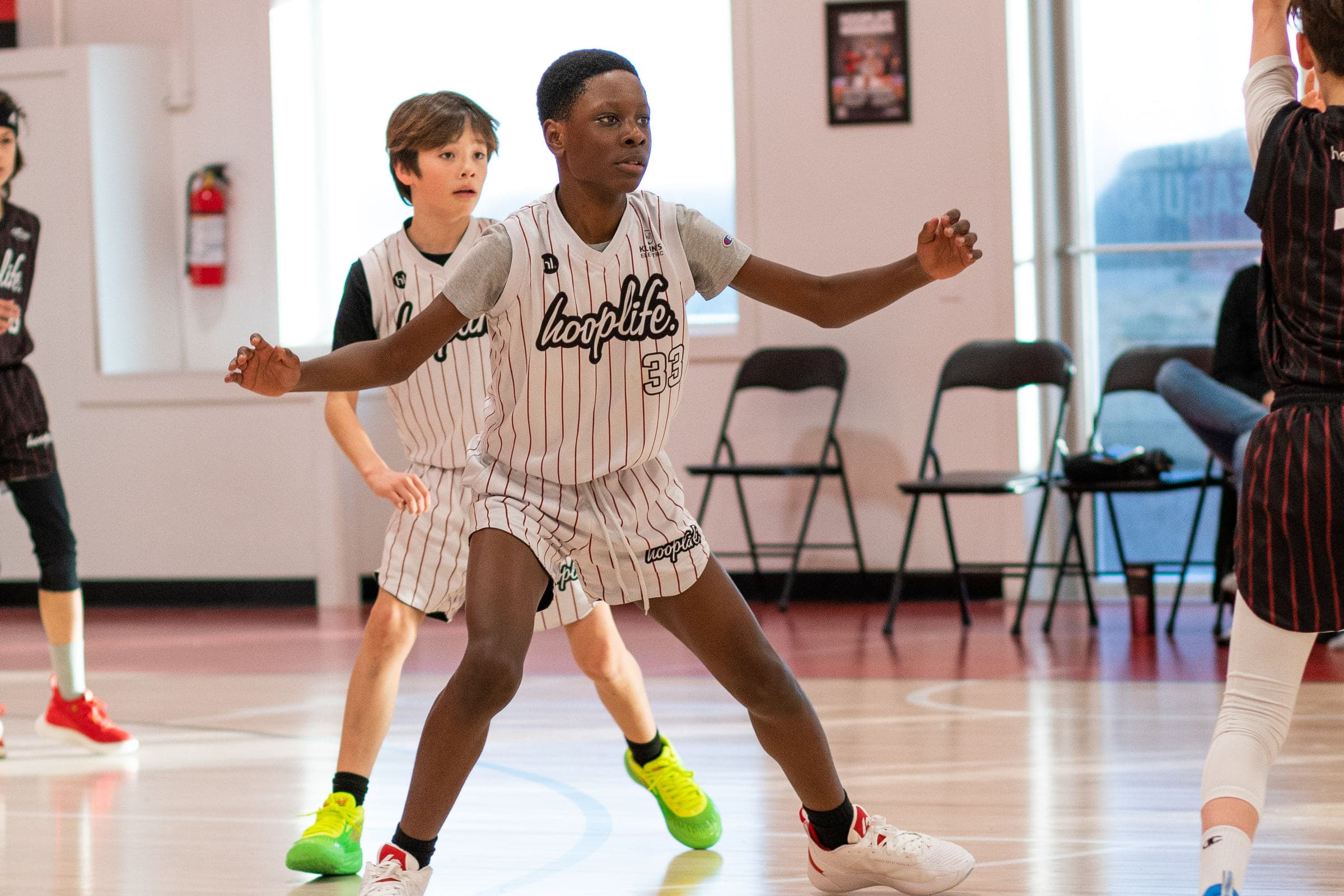
Not a beep test. Play three hard games of 3x3 back to back and watch the third one. The player whose stance is still low and whose hands are still active in game three is basketball fit. The one standing upright reaching at the ball is not, whatever their five-kilometre time says.
Where this fits
Our camps include structured conditioning and mobility built into the day, which across thirty hours in a week does more for a kid's engine than a month of laps. Weekly sessions keep it inside the basketball rather than bolted on at the end, and Girls Only runs the same way. For home, the HoopLife app has conditioning workouts alongside the skill ones.
The conditioning hiding inside a skills session is real too: the 20-minute home workout done at honest speed is a conditioning session wearing a skills costume.
Frequently asked questions
Should young basketball players run laps?
Rarely. Basketball is short repeated efforts with brief recovery, so conditioning that mirrors that pattern, ideally with a ball, transfers far better than steady running.
What is the best conditioning drill for basketball?
Small-sided games such as three-on-three. The work is continuous and realistic, and it trains decision-making at the same time.
Should kids lift weights for basketball?
Not in the adult sense. Bodyweight movement, jumping and landing well, and playing a lot build what a growing athlete needs.
Want the details for your kid?
Leave your info and a real person from HoopLife will send the details and answer your questions. Spots are limited and they do go.