Basketball for Toddlers and Preschoolers: What Actually Works
Yes, a three-year-old can do basketball. No, it does not look like basketball. Here is what it should look like instead, and how to tell a good program from babysitting with a ball.

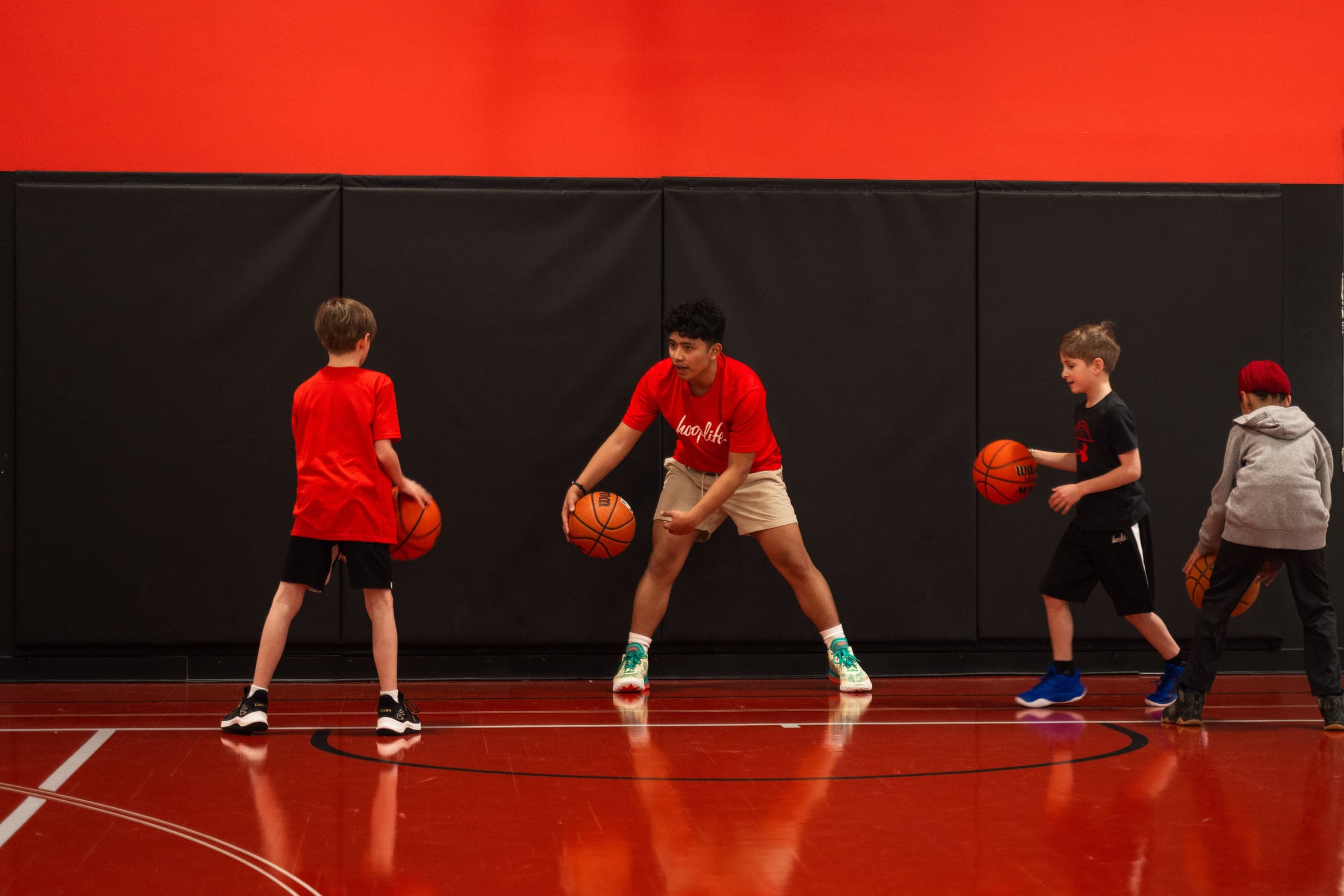
- Ages 3 to 6 learn through games, not drills. A program running lines at this age has it backwards.
- The real curriculum is movement, listening, turn-taking and loving the gym. The hoop is the excuse.
- Look for small groups, an adult-to-kid ratio you can count, and kids who are moving the whole time.
- Young Stars at HoopLife runs four 10-week terms a year for ages 3-4 and 5-6, in separate bands.
Somewhere around a child's third birthday, a lot of parents have the same thought: they never stop moving, they throw everything, maybe basketball. The instinct is right. What most people get wrong is what basketball for a three-year-old should actually look like.
What this age can and cannot do
A 3 to 6 year old is not miniature version of a 10 year old. Their attention runs in ninety-second bursts. Hand-eye coordination for catching arrives on its own schedule, and lowering a hoop does not lower the developmental stage. Most cannot yet dribble in the adult sense, and pushing it produces frustration rather than skill.
What they absolutely can do: run, chase, bounce, roll, throw at targets, balance, copy an adult, take a turn, and fall in love with a place. That list is the actual sport at this age, and a program built on it is doing basketball properly even though it barely resembles the NBA.
Games, never drills
The single test that separates a good early-years program from a bad one. A drill asks a small child to repeat a technique, which they cannot and will not. A game smuggles the same movement inside a story: dribbling becomes driving a car, defensive slides become a crab walk race, shooting becomes feeding the monster.
Watch any session for ten minutes. If the kids are laughing and moving constantly, the coaches understand this age. If children are standing in a line waiting a turn, that program is running a shrunken version of a ten-year-old's practice, and the kids will vote with their feet by Christmas.
What a first class is really like
Expect chaos, and expect the good coaches to be unbothered by it. Somebody cries, somebody runs the wrong way, somebody sits down mid-game to examine the floor. All normal, every week, and a coach who greets that with warmth rather than a whistle is the one you want.
Expect your child to orbit the group for the first week or two before joining it. Watching from the edge IS participating at this age, and dragging them in early usually sets them back. Bring water, expect the class to be short, and judge the program on whether your kid asks to come back, which is the only metric that matters at three.
What they are actually learning
Not a crossover. They are learning that a coach is someone you listen to, that a turn ends and another comes, that trying something in front of people is safe, and that a gym is a happy place. Those four things are the entire foundation that every later basketball skill gets built on, and a child who has them at six is eighteen months ahead of one meeting a coach for the first time.
The physical layer underneath: balance, jumping and landing, throwing, catching a bounced ball, moving in a direction on purpose. Coaches call it physical literacy. It transfers to every sport they will ever try, which is why this age is the one place we would tell you not to worry at all about whether basketball is "their" sport yet.
How Young Stars runs
Young Stars is HoopLife's program for this age, at the HoopLife Centre in Regina, split into two bands so a three-year-old is never in with a six-year-old: ages 3-4 ($150 a term) and ages 5-6 ($250 a term). It runs four 10-week terms a year — Fall, Winter, Spring and Summer — so there is always one running or about to.
It is games-based for every reason above, and it is deliberately a one-off registration rather than a membership, so you are committing to one term at a time. From age 7 kids graduate into weekly skills sessions, where real technique coaching starts, in groups capped at 8.
If you are just testing the waters
Shoot around together at open gym first if you like, $10 and no commitment, though be warned that an unstructured gym is harder work for a parent of a three-year-old than a run class. Or ask us directly: call or text 306-993-4570 and the front desk will tell you honestly whether your kid's age and stage fits the current group.
For the longer view of what comes after this age, when to start each part of the game is here, and what kids learn at each age maps the whole path to seventeen.
Frequently asked questions
Can a 3 year old really do basketball?
Yes, if the program is built for the age: games, movement and turn-taking rather than drills and lines. A 3 year old cannot run a drill, and a good early-years program never asks them to.
What age can kids start basketball at HoopLife?
Young Stars starts at age 3, in two bands: ages 3-4 and ages 5-6. From age 7, kids move into weekly skills sessions with real technique coaching. The Young Stars page has the current term.
What does Young Stars cost?
$150 a term for ages 3-4 and $250 a term for ages 5-6. A term is 10 weeks, and there are four a year: Fall, Winter, Spring and Summer.
My child just watches from the side. Is that normal?
Completely, especially in the first weeks. Watching is how this age joins a group. Good coaches let it happen, and almost every orbiting child is in the middle of the game within a few sessions.
Want the details for your kid?
Leave your info and a real person from HoopLife will send the details and answer your questions. Spots are limited and they do go.