Grades 1-2 Practice #2: Teaching Defence Before Kids Even Notice
Inside HoopLife League practice #2 for grades 1-2 in Regina: how defensive stance, one-hand passing and small-sided games are taught together.

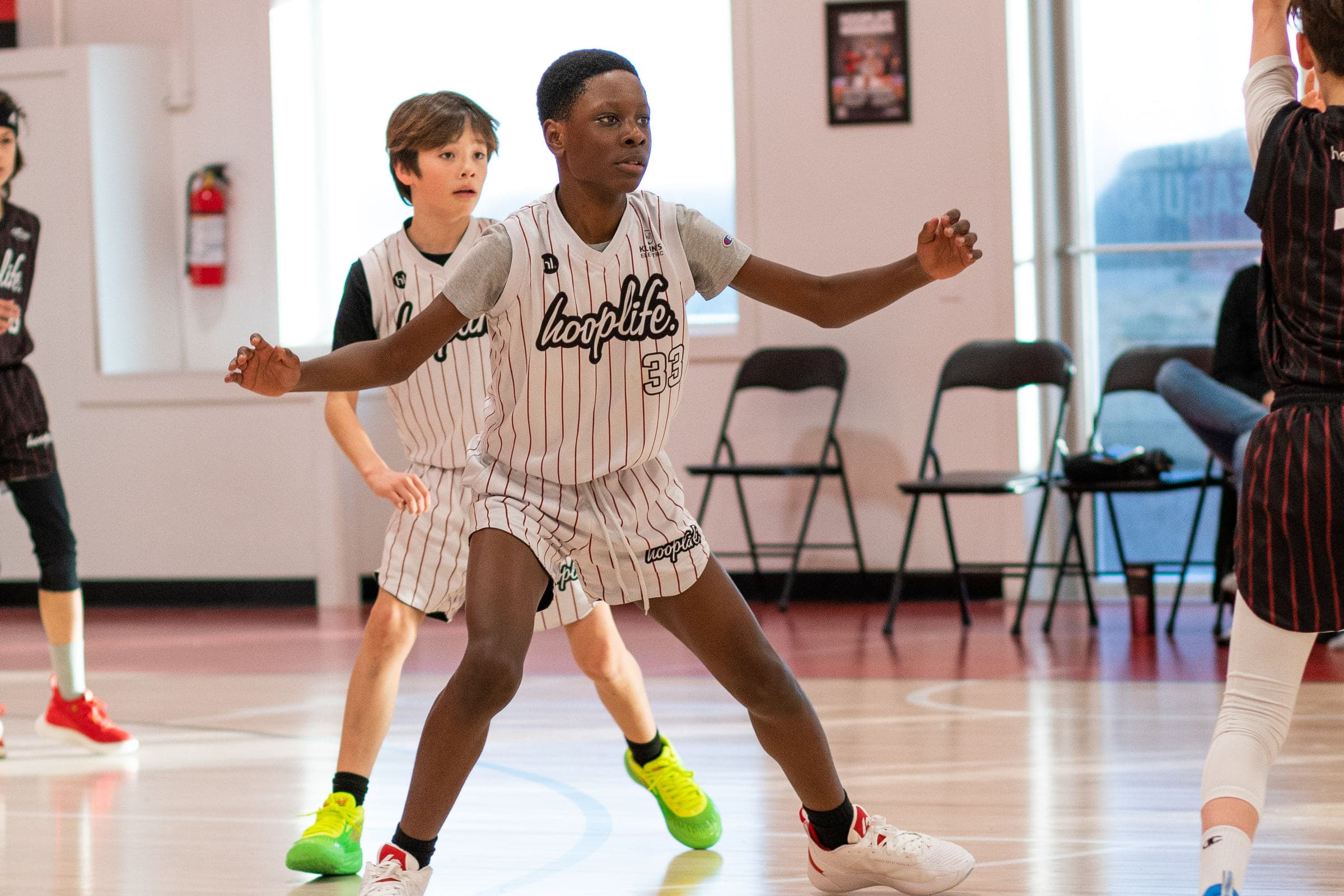
- HoopLife League practice #2 for grades 1-2 opens with 10-12 minutes of warm-up and 5 minutes of explicit defensive stance coaching: knees, back, hands.
- A slow-pace mirror drill with no ball teaches footwork on direction calls (back, left, right, ball on pick up) before any live 1x1 happens.
- Every pass in the 4x0 cutting drill is a one-hand pass, right hand to the right and left hand to the left, with no defender yet in that drill.
- The practice builds from 1x1 to 2x2 to 4x4 to 5x5, adding defensive shifts and weak-side movement gradually rather than starting live 5-on-5.
- Grades 1-2 divisions in the HoopLife League play 3x3 and are popular enough that they do sell out, so registering early matters for getting a spot.
Practice #2 for grades 1-2 in the HoopLife League is built around one idea: a six or seven year old learns defence by being told exactly where their knees, back and hands go, then by moving that way until it is automatic. It is not a scrimmage with a coach yelling "get down." It is stance, then mirroring, then live 1x1, then bigger games, in that order, so the technique survives contact with an actual game.
What does the warm-up actually teach?
The warm-up runs 10 to 12 minutes and includes changing sides of the floor, so kids are moving both directions before anything else starts. Right after that comes 5 minutes on the technical pieces of a defensive stance: knee bend, back position, and hands up and ready. This is taught as a checklist, not a feeling. A coach can look at a seven year old and know in two seconds whether the knees are bent or the back is rounded, and that is exactly what HoopLife coaches are watching for in this block.
From there the practice moves into a slow-pace defensive mirror drill, about 5 minutes, where the coach calls out a direction, back, left, right, or "ball on pick up," and the player reacts with their feet without a ball in play at all. Nobody is trying to score. The whole point is to make the footwork automatic before the offence gets involved.
Why does the practice move to 1x1 so early?
Right after the stance work, the first live drill is 1x1 after the catch. Offence works on layups, defence works on help position, specifically trying to recover so they stay between the ball and the basket. This is the first time a defender has to apply the stance they just built against a real opponent, and it happens fast on purpose. A drill without a live opponent teaches a shape. A drill with a live opponent teaches a decision, and grades 1-2 practice makes that jump early rather than saving it for later in the season.
The second drill layers in passing: every pass in the 4x0 cutting drill is a one-hand pass, right hand to the right, left hand to the left. Players pass, cut, and replace the spot they left. There is no defender yet in this drill, so the focus stays entirely on footwork and delivery. This is one reason HoopLife runs the training block and the games on the same day inside the HoopLife League: the same head coach who taught the stance can watch it show up, or not show up, twenty minutes later in a real possession.
Why small-sided games instead of lines?
The back half of practice is where it all gets tested. A 4x4 live action drill adds defensive shifts, with the instruction to talk, just the word "ball," kept simple for this age. Then a 2x2 drill has the coach specifically watching weak side defensive movement, with position and point players working an offensive exchange, still talking ball and starting to add "low." The last full block before the scrimmage is a half-court sequence, 12 to 15 minutes, of pass, cut, score with a two-foot jump stop layup, then a rebound, then the coach rolls the ball out for another 1x1. Practice closes with 5x5 live game action: offence passing, cutting and filling the empty spot, defence working position, ball and low together.
Every one of those drills is small-sided. Four players, two players, one on one. That is deliberate. In a big group drill, a six year old touches the ball once and stands still the rest of the time. In 2x2 or 1x1, they are involved on almost every possession, which is the same reason HoopLife runs weekly skills sessions capped at 8 players per level. Small groups are not a scheduling choice, they are how a young player actually gets enough touches to learn anything.
What can a player actually take home from this?
The stance and mirror drill needs no ball, no hoop and no gym. A parent can call out "back," "left," "right" and "ball on pick up" in a living room, and a player who gets the footwork right without thinking is doing exactly what this practice is built to produce. At open gym, the piece worth running is the 1x1 after the catch: one player checks the ball in, the other closes out, and the offensive player works a two-foot jump stop into a layup while the defender tries to recover between ball and basket. Doing it right looks like a defender staying low the whole possession, not popping up out of the stance the moment the ball moves.
Divisions for grades 1-2 play 3x3, and those spots are limited. Teams like this fill, and they fill because a lot of families are looking for exactly this kind of coaching for a young player's first season. If a grade 1-2 spot is what a family wants, the honest advice is to sign up as soon as it makes sense, because these divisions do sell out.
Frequently asked questions
How long is HoopLife League practice for grades 1-2? A HoopLife League day for grades 1-2 runs the full session length used across the league: a coached training block followed by two games, with the training block for this practice built around defensive stance, one-hand passing, and small-sided 1x1, 2x2 and 4x4 work before the group plays 5x5.
Does my six or seven year old need to already know defence to join? No. Grades 1-2 practice #2 spends its first ten minutes teaching the actual mechanics of a defensive stance, knee bend, back position, hands up, from scratch, so a first-time player learns it in the room rather than being expected to arrive with it.
Why does HoopLife use small groups instead of full team drills for young kids? Because a young player in a 1x1 or 2x2 drill touches the ball on nearly every possession, while a player standing in a line during a big group drill barely touches it at all, which is why HoopLife's youth sessions and league practices are built around small-sided work.
Do grades 1-2 divisions in the HoopLife League actually fill up? Yes, and they fill quickly because the format is popular with families of young first-time players, so anyone who wants a spot in a grades 1-2 division should register as soon as they decide, since spots are limited and they do go.