Grades 3-4 Practice #2: Teaching DHO Reads Through Small Games
Inside HoopLife's grades 3-4 practice #2 in Regina: how a dribble hand-off, a shell read and small-sided games teach spacing without a single line drill.

- Practice #2 for grades 3-4 builds every drill around reading a dribble hand-off and deciding pass, drive, or cut.
- Drill #1 is 2-on-1 with the coach playing defense, letting the coach control pressure as players learn the read.
- The offense has two starting points depending on the first pass, and both are drilled live at 4-on-4 in the same practice.
- Practice closes with 5-on-5 full court, turning the hand-off and cut into a live transition read.
- HoopLife's weekly skills sessions in Regina are capped at 8 players per level, are popular, and do sell out, so signing up early matters.
Practice #2 for grades 3-4 at HoopLife in Regina is built around one skill: reading a dribble hand-off, then knowing what to do next. There are no shooting lines and no standing in a queue waiting for a turn. Every drill is small-sided, and every drill repeats the same read from a different angle, because that is how a nine-year-old actually learns a decision, not by hearing it once but by making it forty times in twenty minutes.
What is a DHO, and why start here?
DHO stands for dribble hand-off: one player dribbles at a teammate and hands the ball off as they pass, instead of throwing a pass. It sounds small, but it forces two decisions on every single rep, for both the player giving the ball up and the player receiving it. After the warm-up, the whole team runs a 4-on-0 transition concept: hand-off, swing the ball, swing it again, cut, then a drive to the baseline that ends in either a score or a kick-out pass. Nobody is guarding anyone yet. The point of 4-on-0 is pure spacing and timing, so a player learns where their feet go before a defender ever makes it harder.
Why does a coach guard the drill instead of the player?
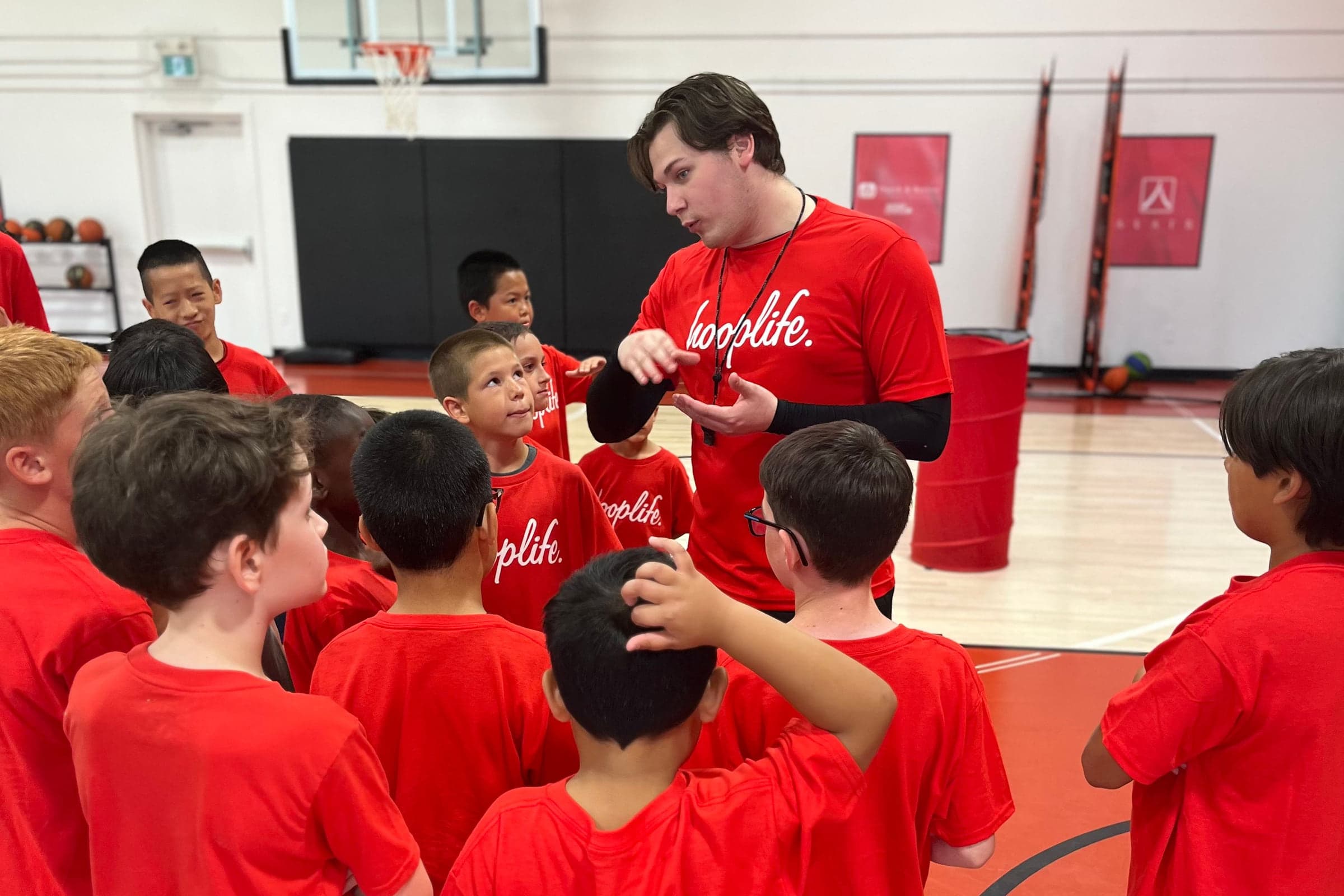
Drill #1 flips the usual setup. It is 2-on-1, and the coach plays defense, not another kid. Right after the hand-off, the coach sticks with one of the two offensive players and forces a quick read: is this a pass or a drive? If the teammate is open, pass and shoot off the catch. If the passing lane is covered, take it yourself. Ten minutes of that, every rep live, is what builds a fast decision instead of a memorized play. A coach guarding the drill can dial the pressure up or down on purpose, holding a gap open for the first few reps and closing it as players start reading it correctly.
Drill #2 raises the numbers to 4-on-4. Now there is a pass, a cut, and a second pass that leads into another hand-off, with the player who is not involved cutting to the post on the side away from the ball. This is where the concept actually gets tested with real defenders in the way, and it is why HoopLife runs skill work in small groups all year, not just in league practices. The same idea shows up in the club's regular 3x3 vs 5-on-5 breakdown: fewer players per side means more touches and more reps of the exact decision a coach is trying to teach.
Why small-sided games instead of lines?
Drills #3 and #4 repeat the pattern at 4-on-0 and then 4-on-4 again, this time built around a pass ahead, an exchange with a cut, and a swing back into another hand-off. There are two ways to start this offense depending on where the first pass goes, and running it both ways in the same practice is deliberate. A player who has only ever seen one starting point freezes the moment a defense forces the other one. Running it live, with real defenders, at 4-on-4, means a coach sees the mistake happen and corrects it on the spot, mid-drill, rather than saving notes for after.
The practice closes with 5-on-5 full court, transition lines off a first pass ahead or a pass from the three-point line, into the opposite movement the team has been drilling all practice. This is the payoff rep: everything from the hand-off to the cut to the read gets tested at game speed and game spacing. Coaches correct on the fly here too. The instruction all through this plan is the same: let players learn it live, don't stop the game to lecture, fix it as it happens.
What can a player actually take home from this?
The hand-off and the read behind it travel well outside a practice gym. Two players and one ball is enough: one dribbles at the other, hands it off, and the receiver has to decide in that instant whether to attack the rim or look to pass, based on where an imaginary defender would be. Doing it right looks like a hand-off with no dead dribble in between and a decision made before the catch is even finished, not after. A parent or teammate at open gym can add pressure just by stepping in front of one option, the same way HoopLife's coach does in Drill #1.
For a family looking for more reps than a driveway can offer, HoopLife runs weekly skills sessions in Regina all year, capped at 8 players per level so every kid actually gets touches instead of standing around. Those sessions are popular and they do sell out, so it is worth signing up as soon as a family decides it is a fit. The HoopLife League itself runs this exact style of practice, with the head coach in the gym every week working from the same written practice book, which is what lets week three build on week two instead of starting over.
Takeaways
- Practice #2 for grades 3-4 builds every drill around one skill: reading a dribble hand-off and deciding pass, drive, or cut.
- Drill #1 is 2-on-1 with the coach playing defense, so pressure can be raised or lowered on purpose as players learn the read.
- The offense has two starting points depending on where the first pass goes, and HoopLife drills both in the same practice.
- Practice closes at 5-on-5 full court, turning every earlier drill into a live transition read.
- HoopLife's weekly skills sessions in Regina are capped at 8 players per level, are popular, and do sell out, so families should sign up as soon as they can.
Frequently asked questions
What is a DHO in basketball, and why does HoopLife teach it to grades 3-4?
DHO stands for dribble hand-off: instead of passing, one player dribbles at a teammate and hands the ball off as they pass by. HoopLife builds practice #2 for grades 3-4 around it because every hand-off forces a fast decision for both players, which is exactly the skill the practice is trying to develop.
Why does the coach play defense in this HoopLife drill instead of another player?
In Drill #1 of this HoopLife practice, the coach guards the 2-on-1 so the pressure on the read can be raised or lowered on purpose. A coach can hold a passing lane open early on and close it once players start reading the hand-off correctly, which a same-age defender can not do as reliably.
Why do HoopLife practices use small-sided games instead of shooting lines?
Small-sided games like the 2-on-1 and 4-on-4 in this HoopLife practice put every player in the action constantly, so a grades 3-4 player gets dozens of live reps of the same decision instead of standing in a line waiting for one turn.
Can a player practice this hand-off concept outside of a HoopLife session?
Yes. The dribble hand-off only needs two players and one ball: one dribbles at the other, hands it off, and the receiver decides instantly whether to drive or look to pass. Adding a defender who steps in front of one option, the way HoopLife's coach does in practice, makes the rep even closer to game speed.
Want the details for your kid?
Leave your info and a real person from HoopLife will send the details and answer your questions. Spots are limited and they do go.