How Basketball Builds Confidence in Kids (and How Parents Can Help)
Confidence is not a pep talk. It is evidence. Here is how a gym produces it, and the one habit in the car that undoes most of it.

- Confidence comes from evidence a child collected themselves, not from being told they are great.
- Small groups matter: a child who is corrected by name learns they are worth coaching.
- Praise the effort and the decision, not the result. The result is mostly outside their control.
- The drive home is the most important ten minutes of the week. Ask, do not review.
Almost every parent who walks into our gym says a version of the same thing. They mention basketball, and then they mention confidence — sometimes before they mention basketball at all.
It is the right instinct. Sport is one of the most reliable confidence-builders there is for a child. But it is worth being precise about why, because the mechanism is not the one most people assume.
Confidence is evidence, not encouragement
Telling a child they are great does very little. Children are excellent at detecting when praise does not match reality, and inflated praise quietly teaches them that your opinion is not information.
What actually builds confidence is evidence they gathered themselves: last month I could not do this, and today I did it. That is why skill work matters so much at this age. A child who could not finish with their left hand in October and can in December is not being told they improved. They know.
This is why every session ends with live play. Drills build the skill; live play is where a kid finds out the skill is real.
What a gym has to get right for this to work
Small enough groups to be seen
A child corrected by name learns that they are worth coaching. A child at the back of a line of thirty learns something else. Our sessions cap at eight, Girls Only at sixteen, 3x3 at sixteen, and a camp at 32 across separate age groups.
A room where mistakes are cheap
A player who is scared to miss stops shooting, then stops moving, then stops enjoying it. The tone of a gym is set by how the adults in it react to a bad play, and that is a coaching decision, not an accident.
Being known
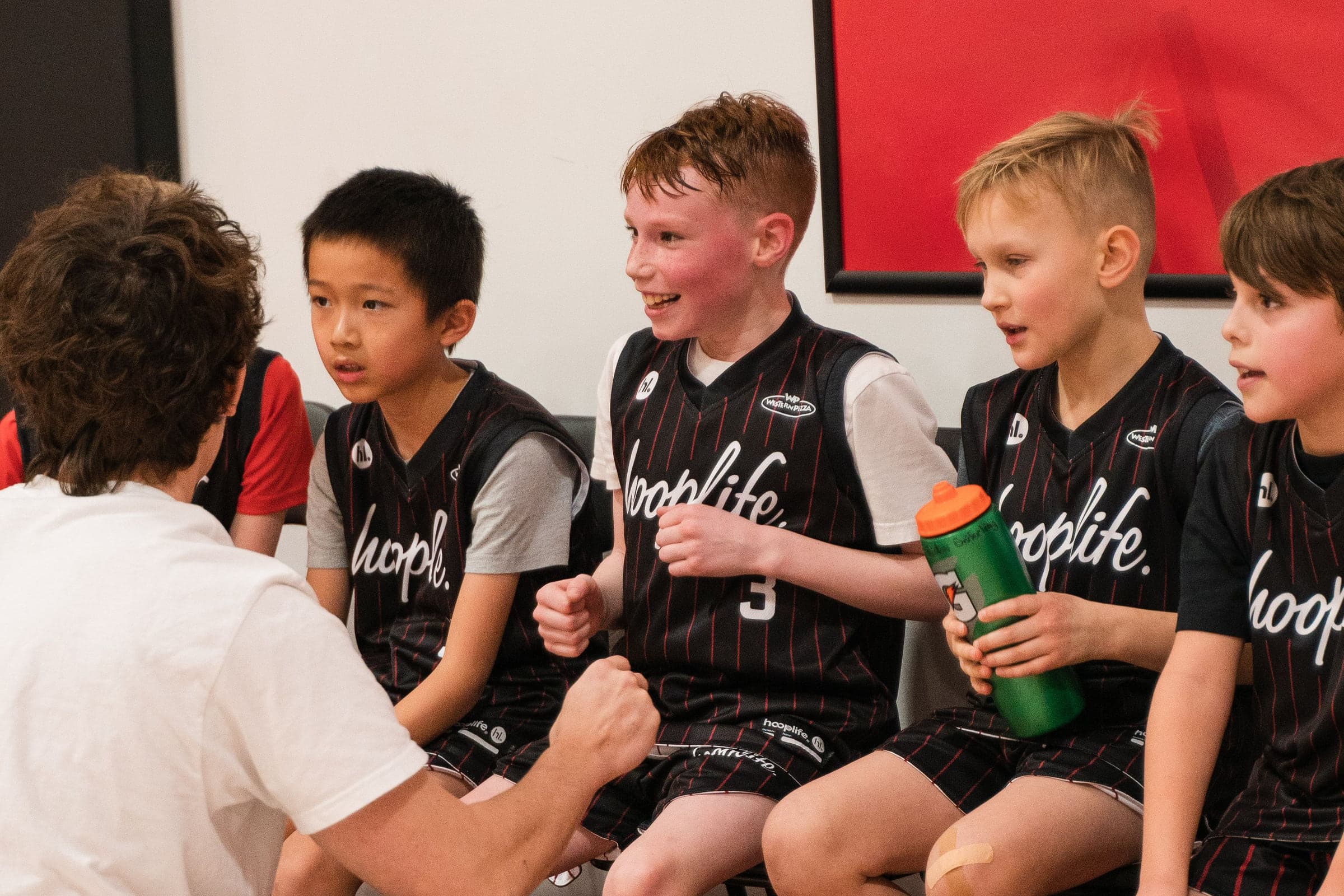
Same coach, same night, same building. Ten weeks with a coach who knows your child's name and their tendencies does something a rotating cast never will. That is a large part of why the league season is built the way it is, with the head coach staying with the team all season and a Confidence, Leadership & Basketball IQ workshop built into every single night.
Something to be part of
Belonging and confidence are close relatives at this age. A kid who has a team, a shirt and a Tuesday night has a place in the world that is theirs, separate from school and from their family.
Four things parents can do
- Praise the decision, not the result. "That was the right pass" holds up whether or not it went in. "Great shot" only holds up when it goes in, which teaches a child that the outcome is the thing that matters.
- Ask, do not review. The drive home should be "what was fun?" and "what was hard?", not a breakdown of their defensive rotations. Most kids will start talking basketball on their own within five minutes if the space is left open.
- Let them be bad at it for a while. The first three months of anything are ugly. A parent who can sit calmly through that period is giving their child permission to keep going.
- Do not out-invest their interest. If they want one day a week, one day a week is right. Enthusiasm survives being under-fed far better than being force-fed.
The part that shows up off the court
The reason we build character work into camps and league days rather than leaving it to chance is that it transfers. A kid who has learned to take a correction without falling apart takes feedback better at school. A kid who has been the one to encourage a struggling teammate does it in a classroom too.
That transfer is most of the point. Basketball is the vehicle.
Where to start
For a nervous child, the smallest door is usually best: one weekly session in a group of eight, or a camp with a friend. For a child who wants to belong to something, a league season does it faster.
If cost is the obstacle, BOOST Kids exists precisely so it does not have to be. And if you want a coach's honest read on your child before committing to anything, that is the $10 Get Started package.
If you want to see what a season of this looks like at scale, here is what a HoopLife League year did for hundreds of Regina kids, and this covers the discomfort half of confidence.
Frequently asked questions
How does sport build confidence in children?
By giving them evidence they collected themselves: visible improvement at something difficult, in front of people, over time. Encouragement supports that; it does not replace it.
My child is shy. Will they be okay in a group?
Weekly skills sessions cap at eight players, which is small enough that a quiet child is noticed and coached rather than lost in a crowd.
What should I say on the drive home?
Ask what was fun and what was hard, then let them lead. Reviewing their performance in the car is the fastest way to make the sport feel like an assessment.
Does HoopLife teach anything beyond basketball skills?
Yes. Every league day includes a Confidence, Leadership and Basketball IQ workshop, and every camp day has a leadership and character block.
Want the details for your kid?
Leave your info and a real person from HoopLife will send the details and answer your questions. Spots are limited and they do go.